
Most of the time, I also fall squarely into the pessimistic “ecological complexity limits predictability” camp. And concerns about prediction in ecology are widespread and understandable. But there is also something frustrating about the way we so often approach ecological prediction. Statements such as “It would be useful to have broad patterns and commonalities in ecology” feel incomplete. Is it that we really lack “broad patterns and commonalities in ecology”, or has ecology adopted a rather precise and self-excoriating definition for “prediction”?
 |
| . |
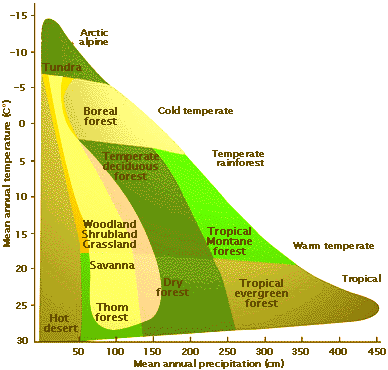
We are fixated on achieving particular forms of prediction (either robust universal relationships, or else precise and specific numerical outputs), and perhaps we are failing at achieving these. But on the other hand, ecology is relatively successful in understanding and predicting qualitative relationships, especially at large spatial and temporal scales. At the broadest scales, ecologists can predict the relationships between species numbers and area, between precipitation, temperature and habitat type, between habitat types and the traits of species found within, between productivity and the general number of trophic levels supported. Not only do we ignore this foundation of large-scale predictable relationships, but we ignore the fact that prediction is full of tradeoffs. As a paper with the excellent title, “The good, the bad, and the ugly of predictive science” states, any predictive model is still limited by tradeoffs between: “robustness-to-uncertainty, fidelity-to-data, and confidence-in-prediction…. [H]igh-fidelity models cannot…be made robust to uncertainty and lack-of-knowledge. Similarly, equally robust models do not provide consistent predictions, hence reducing confidence-in-prediction. The conclusion of the theoretical investigation is that, in assessing the predictive accuracy of numerical models, one should never focus on a single aspect.” Different types of predictions have different limitations. But sometimes it seems that ecologists want to make predictions in the purest, trade-off free sense - robustness-to-uncertainty, fidelity-to-data, and confidence-in-prediction - all at once.
In relation to this, ecological processes tend to be easier to represent in a probabilistic fashion, something that we seem rather uncomfortable with. Ecology is predictive in the way medicine is predictive – we understand the important cause and effect relationships, many of the interactions that can occur, and we can even estimate the likelihood of particular outcomes (of smoking causing lung cancer, of warming climate decreasing diversity), but predicting how a human body or ecosystem will change is always inexact. The complexity of multiple independent species, populations, genes, traits, all interacting with similarly changing abiotic conditions makes precise quantitative predictions at small scales of space or time pretty intractable. So maybe that shouldn’t be our bar for success. The analogous problem for an evolutionary biologist would be to predict not only a change in population genetic structure but also the resulting phenotypes, accounting for epigenetics and plasticity too. I think that would be considered unrealistic, so why is that where we place the bar for ecology?
In part the bar for prediction is set so high because the demand for ecological knowledge, given habitat destruction, climate change, extinction, and a myriad of other changes, is so great. But in attempting to fulfill that need, it may be worth acknowledging that predictions in ecology occur on a hierarchy from those relationships at the broadest scale that we can be most certain about, moving down to the finest scale of interactions and traits and genes where we may be less certain. If we see events as occurring with different probabilities, and our knowledge of those probability distributions declining the farther down that hierarchy we travel, then our predictive ability will decline as well. New and additional research adds to the missing or poor relationships, but at the finest scales, prediction may always be limited.


